


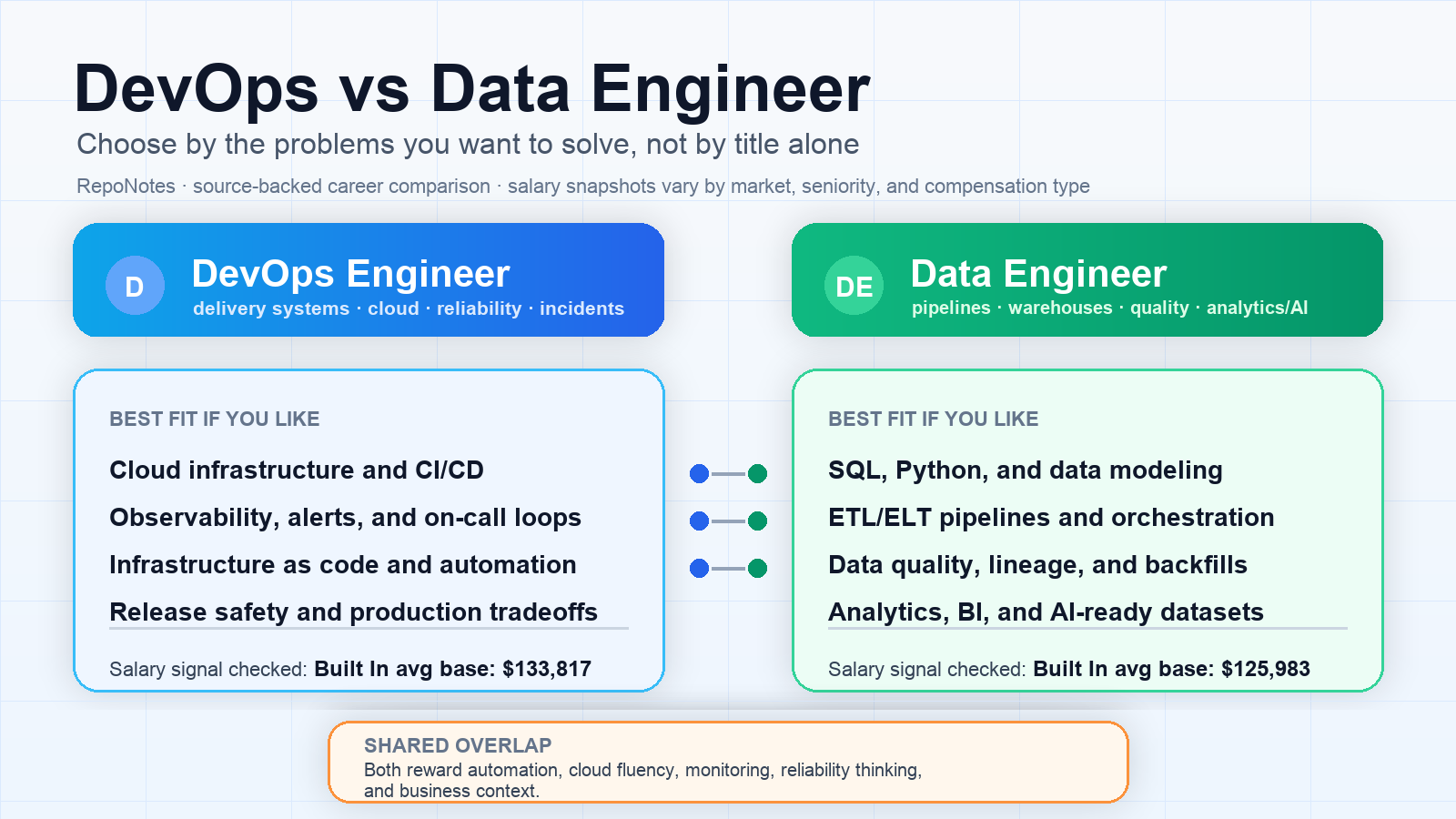
DevOps and data engineering are both technical, high-leverage career paths, but they solve different business problems. DevOps keeps software delivery and production systems reliable. Data engineering keeps data pipelines, storage, and analytics-ready datasets reliable. The salary comparison matters, but it should not be the only reason to choose one path.
Quick answer: choose DevOps if you want cloud infrastructure, CI/CD, observability, automation, and incident-driven reliability work. Choose data engineering if you want SQL, Python, data pipelines, warehouses, quality checks, and analytics or AI platform work.
This refresh separates three questions that often get mixed together: which role pays more, what each role actually does, and which one fits your skills and career direction. Salary snapshots are sourced and caveated because salary sites disagree by methodology, location, seniority, and whether they count base pay or total compensation.
DevOps vs Data Engineer: The Short Comparison
DevOps engineers work around the path from code to production. They build deployment pipelines, automate infrastructure, monitor systems, respond to incidents, and reduce the friction between development and operations. AWS describes DevOps as improving an organization’s ability to deliver applications and services at high velocity, with development and operations teams no longer treated as separate silos.
Data engineers work around the path from raw data to trusted data products. IBM defines data engineering as designing and building systems for the aggregation, storage, and analysis of data at scale. In practice, that means data intake, storage, transformation, orchestration, quality checks, and the pipelines that analytics, BI, and machine learning teams depend on.
| Dimension | DevOps Engineer | Data Engineer |
|---|---|---|
| Primary outcome | Reliable software delivery and production operations | Reliable data pipelines, storage, and analysis-ready datasets |
| Core systems | CI/CD, cloud infrastructure, containers, IaC, observability | Warehouses, lakes, ETL/ELT, orchestration, streaming, data quality |
| Typical incidents | Deployment failure, outage, latency, broken rollback, capacity issue | Pipeline failure, missing data, schema drift, slow query, bad data quality |
| Best fit | People who like systems, automation, cloud, and reliability tradeoffs | People who like data models, SQL, Python, pipelines, and analytics workflows |
Salary Snapshot: What the Readable Sources Say
Salary is useful as a market signal, but it is easy to overread. The same job title can mean different things across companies: a DevOps engineer might own platform engineering and on-call reliability at one company, while another uses the title for CI/CD support. A data engineer might be a warehouse-focused analytics engineer in one team and a streaming platform engineer in another.
| Role | Readable source checked | US salary signal | How to interpret it |
|---|---|---|---|
| DevOps Engineer | Built In DevOps Engineer Salary in US | Average base salary: $133,817 | Useful base-pay snapshot; not a guarantee for every location or seniority level |
| Data Engineer | Built In Data Engineer Salary in US | Average base salary: $125,983; average total compensation: $150,234 | Shows how additional cash compensation can change the comparison |
| DevOps Engineer | Coursera DevOps Engineer Salary 2026 | US averages commonly framed between $116,000 and $180,000 | Useful range-based context; depends heavily on experience and location |
The safest takeaway: DevOps and data engineering can both pay well. DevOps may show stronger base-pay signals in some salary snapshots, while data engineering can become very lucrative when the role moves closer to real-time systems, analytics platforms, machine learning data, or senior data architecture. Compare offers by total compensation, scope, on-call expectations, growth path, and the quality of the team, not only by title.
What DevOps Engineers Actually Do
A DevOps engineer is paid to make delivery safer and operations less painful. The job usually sits between software engineering, infrastructure, security, and operations. The best DevOps work is not “just scripts”; it is the design of reliable delivery systems that help developers ship without breaking production.
- Build and maintain CI/CD pipelines for build, test, release, rollback, and deployment automation.
- Manage cloud infrastructure, networking, IAM boundaries, secrets, and environments.
- Use infrastructure as code tools such as Terraform, CloudFormation, Pulumi, or similar systems.
- Run observability: logs, metrics, traces, alerts, dashboards, and incident response loops.
- Improve reliability through safer deploys, capacity planning, disaster recovery, and post-incident fixes.
- Connect engineering teams with platform, security, compliance, and operations requirements.
If that sounds familiar, the related RepoNotes guides on DevOps examples, DevOps monitoring tools, and AWS features for DevOps engineers show the kind of work that often appears in real roles.
What Data Engineers Actually Do
A data engineer is paid to make data usable, trustworthy, and available at scale. The work is less about dashboards and more about the systems behind the dashboards: pipelines, storage, schemas, transformations, data contracts, orchestration, governance, and performance.
- Ingest data from applications, SaaS tools, events, logs, files, databases, and third-party sources.
- Design storage and transformation layers in warehouses, lakes, lakehouses, or streaming systems.
- Build ETL or ELT pipelines with orchestration, retries, monitoring, and data quality checks.
- Model data so analytics, BI, finance, product, and ML teams can trust the results.
- Handle schema changes, backfills, late-arriving data, lineage, access controls, and performance tuning.
- Work with stakeholders to turn messy source systems into reliable datasets.
For adjacent technical context, see RepoNotes guides on Kafka Streams, AWS DMS migration runbooks, and Looker for analytics engineering. Those are not the whole data engineering field, but they show the pipeline, migration, and analytics platform side of the work.
Skills Comparison
The overlap is real: both roles use automation, cloud services, scripting, monitoring, and production thinking. The difference is the system they optimize. DevOps optimizes delivery and runtime reliability. Data engineering optimizes data flow, trust, and analytical usefulness.
| Skill area | DevOps emphasis | Data engineering emphasis |
|---|---|---|
| Programming | Bash, Python, Go, YAML, pipeline scripts | SQL, Python, Spark, dbt, data transformation code |
| Cloud | Compute, networking, IAM, containers, CI/CD, observability | Storage, warehouses, lakes, orchestration, managed data services |
| Reliability | Deployments, rollback, SLOs, alerting, incident response | Pipeline SLAs, data quality, lineage, retries, backfills |
| Security | Secrets, IAM, supply chain, network boundaries, compliance automation | Data access, privacy, governance, masking, retention, auditability |
| Stakeholders | Developers, SRE, platform, security, operations | Analytics, product, finance, data science, ML, executives |
Which Role Should You Choose?
Choose DevOps if you enjoy systems that are alive in production. The work rewards people who can stay calm during incidents, automate repeated pain, understand cloud primitives, and make deployment safer for everyone else. If you like infrastructure diagrams, pipelines, logs, alerts, and reliability tradeoffs, DevOps is probably the better fit.
Choose data engineering if you enjoy turning messy inputs into trusted data products. The work rewards people who like SQL, Python, schemas, transformation logic, orchestration, data quality, and collaboration with analytics or ML teams. If you like asking “where did this number come from?” and building systems that make the answer reliable, data engineering is probably the better fit.
| If you prefer… | Lean DevOps | Lean Data Engineering |
|---|---|---|
| Cloud infrastructure and deployment systems | Yes | Sometimes |
| SQL, data modeling, and analytics workflows | Sometimes | Yes |
| Incident response and on-call reliability | Yes | Occasionally |
| Data quality and pipeline correctness | Occasionally | Yes |
| AI and analytics platform work | Possible through MLOps/platform | More direct path |
| Platform engineering career path | Very direct | Possible if focused on data platforms |
Career Path and Long-Term Ceiling
DevOps can grow into senior DevOps, SRE, platform engineering, cloud architecture, infrastructure leadership, security engineering, or engineering management. The ceiling rises when the role moves from ticket-driven support to productized platform ownership: golden paths, developer experience, reliability strategy, cloud cost controls, and secure delivery systems.
Data engineering can grow into senior data engineer, analytics engineer, data platform engineer, data architect, ML platform engineer, or data engineering manager. The ceiling rises when the role owns business-critical data products, real-time systems, governance, self-service analytics, or AI-ready data platforms.
If you want a practical hiring view, the RepoNotes guide on DevOps recruiting strategies explains how teams evaluate infrastructure and delivery skills. For broader interview prep, start with the DevOps interview prep hub.
Common Mistakes When Comparing These Roles
- Comparing one salary source as if it represents the whole market.
- Ignoring total compensation, bonus, equity, on-call load, and remote-work location.
- Treating DevOps as only CI/CD or data engineering as only SQL.
- Assuming data engineering always leads to AI work. Some roles are mostly warehouse maintenance.
- Assuming DevOps always means strategic platform work. Some roles are mostly operational support.
- Choosing based on salary alone instead of the problems you can tolerate every week.
Bottom Line
DevOps and data engineering are both strong career paths, but they are not interchangeable. DevOps is the better fit if you want to improve delivery systems, cloud infrastructure, observability, and production reliability. Data engineering is the better fit if you want to build data pipelines, storage layers, and trustworthy datasets for analytics and AI.
For salary, compare source-backed snapshots carefully. Built In’s readable US pages show strong salary signals for both roles, and Coursera’s DevOps salary article reinforces that location, seniority, specialization, and experience can swing the number. The better decision is not “which title wins?” It is “which problems do I want to get good at solving for the next three to five years?”
FAQ
Is DevOps harder than data engineering?
Neither role is universally harder. DevOps is harder if you dislike production incidents, cloud infrastructure, networking, and release risk. Data engineering is harder if you dislike SQL, data modeling, pipeline reliability, and debugging data quality problems across systems.
Which pays more, DevOps or data engineering?
The answer depends on source, location, seniority, and whether you compare base salary or total compensation. In the readable US sources checked for this refresh, Built In lists a higher average base salary for DevOps engineers, while its Data Engineer page exposes meaningful additional cash compensation. Treat the numbers as market signals, not guarantees.
Can a DevOps engineer become a data engineer?
Yes. The fastest bridge is usually Python, SQL, orchestration, cloud storage, and batch or streaming pipelines. DevOps engineers already understand automation, deployment, monitoring, and reliability, which helps when data platforms need production-grade operations.
Can a data engineer move into DevOps?
Yes, especially if they already work with cloud infrastructure, CI/CD, containers, orchestration, and monitoring. The main gap is usually production operations: incident response, infrastructure as code, networking, security boundaries, and deployment reliability.
Which role is better for cloud careers?
DevOps is usually the more direct cloud infrastructure path because it touches CI/CD, compute, networking, IAM, observability, and platform automation. Data engineering is also cloud-heavy, but the focus is more on data lakes, warehouses, pipelines, transformation jobs, and analytics or AI-ready datasets.
Which role is better for AI and analytics work?
Data engineering is closer to AI and analytics because it prepares the datasets, pipelines, and storage layers that analytics and machine learning teams depend on. DevOps can still support AI platforms through MLOps, deployment, GPUs, monitoring, and platform reliability, but it is less centered on data modeling.

Leave a Reply