

AWS services can feel like a catalog of more than 200 names, but developers do not need a catalog first. They need an order of operations: which services to learn first, what each one does in a real application, and when to branch into deeper runbooks.
Quick takeaway: treat this as a developer route map, not an AWS encyclopedia. Start with IAM, AWS CLI, one compute path, one storage path, one database path, and one deployment path. Then follow the linked RepoNotes runbooks when the service becomes part of your actual system.
AWS describes its platform as a broad set of global cloud products across compute, storage, databases, analytics, networking, developer tools, security, and enterprise applications in the AWS overview whitepaper. This guide turns that catalog into a developer route map, with links into RepoNotes pages where a service needs a dedicated runbook.
The Developer Mental Model
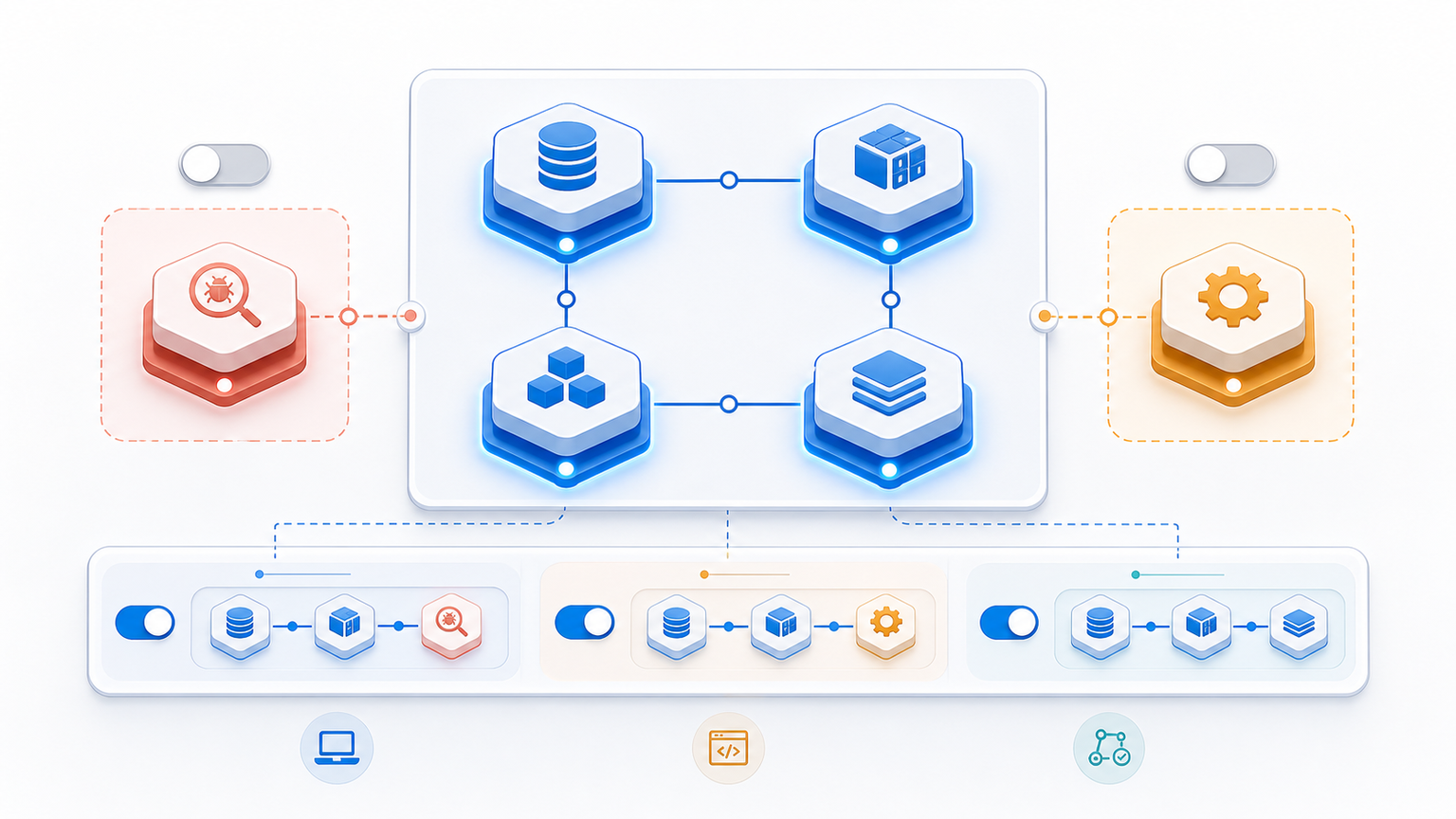
A useful AWS mental model is not “memorize every service.” It is “pick the smallest set that lets me ship a safe system.” Most developer projects need five layers.
| Layer | Start With | What It Helps You Decide |
|---|---|---|
| Identity and guardrails | IAM, Organizations, budgets | Who can do what, how accounts are separated, and how to avoid root-account or surprise-billing mistakes. See AWS IAM Roles and AWS Organizations. |
| Access and workflow | AWS CLI, CloudShell, SDKs | How you inspect resources, automate checks, and avoid clicking through the console forever. Start with the AWS CLI guide. |
| Compute | EC2, Lambda, containers | Where code runs: virtual machines, event-driven functions, or container platforms. The simplest first deep dive is often Lambda Layers. |
| Storage and data | S3, RDS, DynamoDB, FSx | Where state lives and how access patterns shape the design. Compare relational and NoSQL choices in Amazon RDS vs DynamoDB. |
| Networking and delivery | VPC, load balancing, VPN, peering | How services talk to each other and to users. Start with VPC Peering and Site-to-Site VPN when networks cross boundaries. |
Services to Learn First
This is the practical order I would use for a developer or DevOps engineer who wants useful AWS fluency without turning the first month into a certification cram session.
1. IAM: Access Before Architecture
IAM controls human access, workload access, roles, policies, and permissions. AWS also recommends security best practices such as protecting the root user and applying least privilege in the IAM best practices documentation. For a modern setup, use IAM Identity Center for workforce access where it fits, and use roles for applications and AWS services. For developers, IAM matters because almost every broken AWS workflow eventually becomes a permissions problem.
- Use roles for workloads instead of long-lived access keys where possible.
- Give developers enough access to build, but not enough to accidentally delete production.
- Use AWS Organizations when accounts need separation between sandbox, staging, and production.
2. AWS CLI: Your Reality Check Tool
The console is useful for discovery, but the AWS CLI is what makes AWS repeatable. Developers should be able to verify identity, region, and resource state from a terminal before they trust a tutorial or deployment script.
aws sts get-caller-identity
aws configure list
aws configure get regionCode language: Bash (bash)
For practical command patterns across EC2, EBS, and S3, use the RepoNotes AWS CLI command guide as the next step.
3. Compute: EC2, Lambda, and Containers
Compute is where code runs. EC2 gives you virtual machines. Lambda gives you event-driven functions without managing servers. ECS with Fargate or EKS gives you AWS-managed container paths when packaging and orchestration matter.
| Use This | When It Fits | Watch Out For |
|---|---|---|
| EC2 | You need OS-level control, long-running processes, custom networking, or traditional server hosting. | Instance sizing, patching, EBS volumes, security groups, and cost drift. |
| Lambda | You need short-lived event handlers, scheduled automation, API handlers, or file-processing jobs. | Deployment package size, cold starts, IAM permissions, and dependency reuse. See Lambda Layers. |
| ECS/Fargate or EKS | You need portable runtime packaging and a clearer path from local development to production. | Cluster operations, image security, service discovery, logging, and the choice between simpler managed containers and Kubernetes control. |
4. Storage and Databases: S3, RDS, DynamoDB, and FSx
Most AWS mistakes come from choosing storage too early. Start with access pattern, not service popularity. Object files usually belong in S3. Relational data often starts in RDS. High-scale key-value or document patterns may fit DynamoDB. Windows file shares or specialized file workloads can point to FSx.
| Need | Likely Service | RepoNotes Deep Dive |
|---|---|---|
| Static files, backups, exports, object storage | Amazon S3 | Use bucket policy, lifecycle, and encryption basics before adding complexity. |
| Relational application data | Amazon RDS | RDS vs DynamoDB |
| High-scale key-value access | DynamoDB | RDS vs DynamoDB |
| Managed file systems | Amazon FSx | Amazon FSx |
5. Networking: VPC, Peering, VPN, and Private Paths
A developer does not need to become a network engineer on day one, but they do need to know the difference between public access, private subnets, route tables, security groups, and cross-network connectivity. Without that, debugging “the app cannot reach the database” becomes guesswork.
- Use VPC Peering for private connectivity between compatible VPCs when transitive routing is not required.
- Use Site-to-Site VPN when AWS needs to connect to an on-premises or external network.
- Treat security groups as application-level firewalls, not as documentation afterthoughts.
6. Deployment, Infrastructure as Code, and Migration
Once you can run and secure an application, split the next layer into two paths. Deployment and infrastructure as code usually means CodePipeline, CodeBuild, CodeDeploy, CDK, and CloudFormation. Migration and data movement usually means DMS, DataSync, Glue, or Transfer Family. Do not mix those paths until you know whether the problem is shipping code or moving data.
For database migration work, RepoNotes has an AWS DMS migration runbook. For architecture quality, use the AWS Well-Architected Framework as a checklist while you design and review the system.
A Practical Learning Path by Role
Different developers need different first services. A frontend engineer, backend engineer, DevOps engineer, and data engineer should not all learn AWS in the same order.
| Role | First AWS Services | Reasonable Next Step |
|---|---|---|
| Frontend or full-stack developer | S3, CloudFront, Route 53, Lambda, API Gateway, Cognito | Deploy a small static app plus one backend endpoint. |
| Backend developer | IAM, CLI, Lambda or EC2, RDS, DynamoDB, SQS, CloudWatch | Build one API with logs, alarms, and least-privilege access. |
| DevOps or platform engineer | IAM, Organizations, VPC, EC2, ECS/EKS, CodePipeline, CloudWatch, Systems Manager | Create a repeatable environment path from sandbox to production. |
| Data or analytics engineer | S3, Glue, Athena, RDS, DynamoDB, DMS, Redshift | Move one dataset, query it, and document ownership and cost. |
A Concrete First Project Path
If you need one small path instead of a full map, build a tiny API and force every AWS service to earn its place: IAM and CLI first, Lambda or EC2 for compute, API Gateway if it is HTTP-facing, DynamoDB or RDS for data, CloudWatch for logs, and a budget cleanup step at the end.
- Verify who you are with
aws sts get-caller-identity. - Create the smallest role or permission set that lets the app run.
- Deploy one endpoint, one data store, and one log trail.
- Delete or shut down the resources when the test is done.
What to Avoid When Learning AWS
The most expensive AWS learning path is opening random services in the console until something works. Use a sandbox account, budget alerts, and explicit cleanup habits. The AWS Free Tier can help you understand what is free, but it does not remove the need for budgets and alerts.
- Do not use the root account for daily learning.
- Do not leave tutorial resources running overnight unless you know the cost model.
- Do not paste admin policies into every role just to unblock a tutorial.
- Do not learn services in isolation. Connect each service to a real job in your application.
- Use this hub for orientation, then move into service-specific runbooks when you need implementation detail.
AWS Services Cheat Sheet for Developers
Use this as a quick “what should I search next?” map when a tutorial or architecture diagram mentions an AWS service.
| Problem | AWS Services to Check | First Question to Ask |
|---|---|---|
| Run application code | EC2, Lambda, ECS, EKS, Elastic Beanstalk | Do I need server control, event functions, or container orchestration? |
| Store files | S3, EFS, FSx | Is this object storage, shared file storage, or Windows/Linux file system support? |
| Store application data | RDS, DynamoDB, Aurora, ElastiCache | Is the data relational, key-value, cache-heavy, or globally distributed? |
| Connect networks | VPC, peering, Transit Gateway, VPN, Direct Connect | Is this same-region VPC connectivity, hybrid connectivity, or multi-account routing? |
| Ship code | CodePipeline, CodeBuild, CodeDeploy, CDK, CloudFormation | Do I need a deployment pipeline, infrastructure as code, or both? |
| Move data | DMS, DataSync, Transfer Family, Glue | Is this database migration, file transfer, or ETL? |
| Protect access | IAM, Organizations, KMS, Secrets Manager, GuardDuty | Who or what needs access, and what is the smallest safe permission set? |
Recommended Next Reads
If you want the shortest useful route through the existing RepoNotes AWS cluster, use this order:
- First: AWS IAM Roles and AWS CLI for EC2, EBS, and S3.
- Then: AWS Lambda Layers if you build serverless applications.
- Then: Amazon RDS vs DynamoDB before choosing a database.
- Then: Amazon VPC Peering and AWS Site-to-Site VPN when networking becomes real.
- For account strategy: AWS Organizations and Close an AWS Account Safely.
- For business context: Companies Using AWS.
FAQ
Which AWS service should developers learn first?
Start with IAM and the AWS CLI, then learn one compute service such as Lambda or EC2, one storage service such as S3, and one database path such as RDS or DynamoDB. IAM and CLI skills make every later service easier to debug.
Is AWS Lambda or EC2 better for beginners?
Lambda is often easier for small event-driven projects because you do not manage servers. EC2 is better when you need OS-level control, long-running processes, custom networking, or traditional server behavior.
Do developers need to learn AWS networking?
Yes, but start with the basics: VPCs, subnets, route tables, security groups, and when private connectivity is needed. You do not need advanced networking first, but you do need enough to debug access and connectivity failures.
What is the safest way to practice AWS?
Use a sandbox account, enable MFA, create budgets or billing alerts, avoid root-user daily work, and delete tutorial resources after testing. Treat cost and IAM as part of the learning path, not as cleanup after the fact.
How is this AWS services guide different from the official AWS overview?
The official overview lists the platform. This guide organizes core AWS services by developer job-to-be-done and routes readers into practical RepoNotes runbooks for IAM, CLI, compute, data, networking, migration, and account management.

Leave a Reply