


Essential AWS features are not a random list of shiny services. For DevOps engineers, the useful question is simpler: which AWS features show up in access control, networking, deployments, monitoring, automation, and incident response?
For the broader route map, see our AWS services for developers guide.
Quick takeaway: Keep the keyword, but treat it as a service map. The essential AWS features for DevOps work are IAM, VPC, EC2, S3, CloudWatch, Lambda, ECS/EKS, Systems Manager, and Organizations. Learn them by operational job, not by AWS marketing category.
This guide is intentionally different from broad DevOps skills or toolstack posts. It focuses on AWS features a DevOps engineer actually touches in production. If you need deeper command examples, pair it with the AWS CLI for EC2, EBS, and S3 guide.
Essential AWS Features by DevOps Job
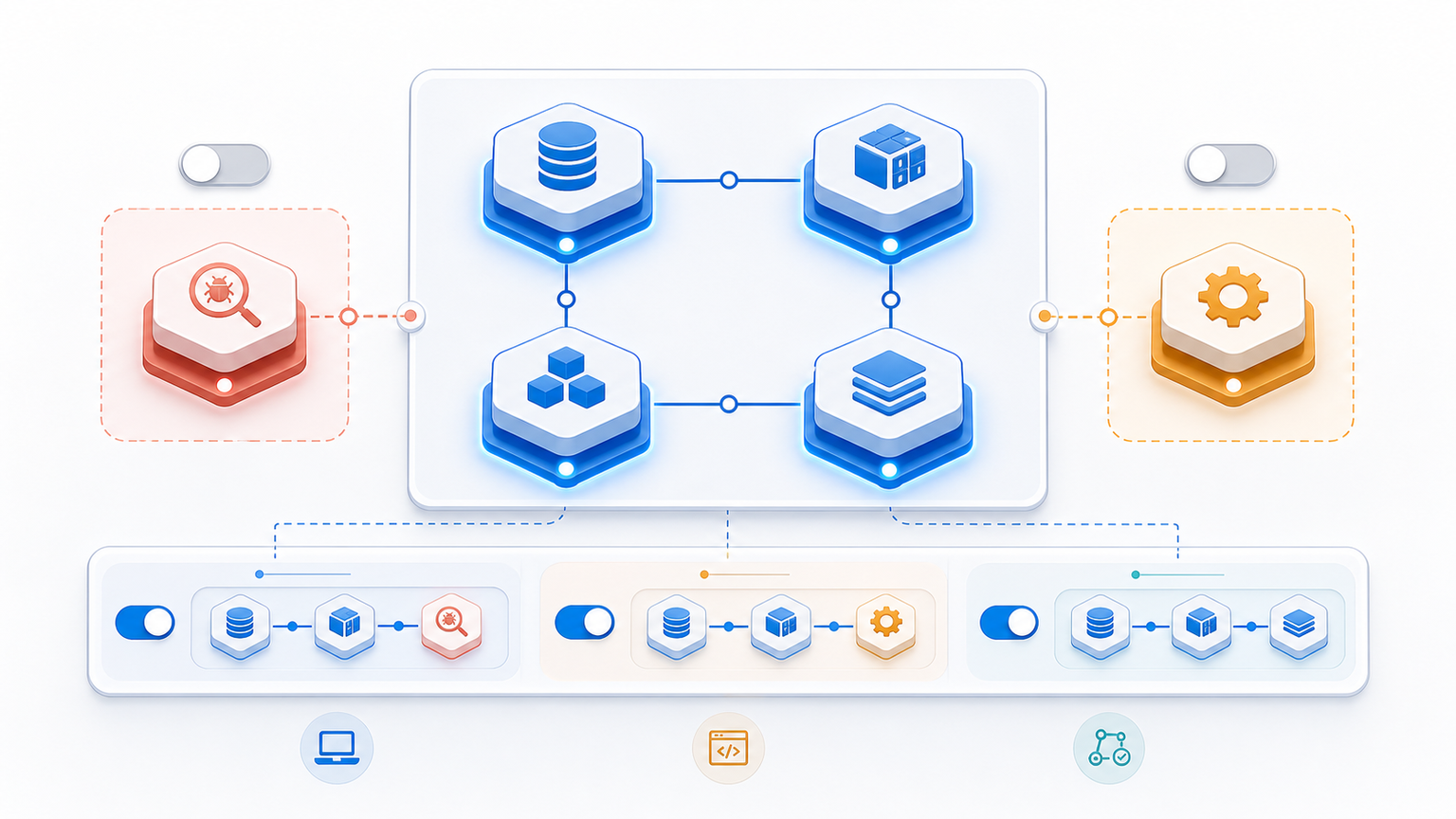
A clean way to learn AWS is to map each service to a job you will perform. That keeps the learning path practical and reduces overlap with generic “top tools” articles.
| DevOps job | Essential AWS feature | Why it matters |
|---|---|---|
| Control access | IAM | Every deployment, pipeline, automation script, and emergency action depends on safe permissions. |
| Design network boundaries | VPC | Production systems need subnets, routing, security groups, private endpoints, and hybrid connectivity. |
| Run compute workloads | EC2, Lambda, ECS, EKS | Different workloads need virtual machines, serverless functions, managed containers, or Kubernetes. |
| Store artifacts and data | S3, EBS, RDS, DynamoDB | DevOps teams manage deployment artifacts, backups, state, logs, and application data paths. |
| Observe and respond | CloudWatch | Logs, metrics, alarms, and dashboards turn production behavior into operational signals. |
| Automate operations | Systems Manager | Patch, inventory, run commands, and manage fleet operations without one-off SSH habits. |
| Govern accounts | Organizations | Multi-account AWS needs guardrails, account structure, consolidated billing, and policy boundaries. |
IAM: The Access Control Foundation
AWS IAM is the first essential feature because everything else depends on it. A DevOps engineer needs to understand users, groups, roles, policies, trust relationships, temporary credentials, and least privilege.
The practical skill is not memorizing every IAM option. It is knowing when a workload should assume a role, when a human should use federated access, and how to debug permission failures without granting broad admin access. For a deeper treatment, read the AWS IAM roles guide.
VPC: The Network Boundary You Troubleshoot First
Amazon VPC defines how AWS resources communicate. DevOps engineers do not need to become network architects on day one, but they do need to understand subnets, route tables, security groups, network ACLs, NAT gateways, endpoints, and connectivity patterns.
This matters during incidents. Many “the app is down” problems are really routing, DNS, security-group, or endpoint problems. For hybrid routing and tunnels, the AWS Site-to-Site VPN guide is the natural companion.
EC2, Lambda, ECS, and EKS: Compute Choices
Amazon EC2, AWS Lambda, Amazon ECS, and Amazon EKS represent different compute models. EC2 gives control over virtual machines. Lambda runs event-driven code without server management. ECS gives managed container orchestration. EKS brings Kubernetes into AWS.
| Compute feature | Best fit | DevOps responsibility |
|---|---|---|
| EC2 | Long-running services, legacy apps, custom AMIs, direct OS control. | Patching, scaling, bootstrap scripts, instance profiles, monitoring, and recovery. |
| Lambda | Event-driven jobs, small APIs, automation glue, async workflows. | Permissions, packaging, logs, timeouts, retries, and dependency layers. |
| ECS | Container workloads without full Kubernetes overhead. | Task definitions, services, deployments, image flow, scaling, and logging. |
| EKS | Teams already standardizing on Kubernetes. | Cluster upgrades, add-ons, IAM integration, node groups, ingress, and observability. |
If your team is container-first but does not need Kubernetes complexity, AWS Fargate can be worth reviewing before jumping straight to EKS. For serverless reuse patterns, see AWS Lambda layers.
S3, EBS, RDS, DynamoDB, FSx, and DMS: Storage and Data Paths
Amazon S3 is essential because it appears everywhere: artifacts, logs, backups, static assets, data lakes, and pipeline outputs. DevOps engineers also need enough storage knowledge to reason about EBS volumes, database choices, file systems, and migration paths.
| Feature | DevOps use case | What to watch |
|---|---|---|
| S3 | Artifacts, logs, backup targets, static files, data exchange. | Bucket policies, encryption, versioning, lifecycle rules, and public access settings. |
| EBS | Block storage for EC2 workloads. | Volume type, snapshots, attachment, resize workflows, and backup policy. |
| RDS / DynamoDB | Managed relational and NoSQL data stores. | Access patterns, backups, scaling model, failover, and cost behavior. |
| FSx | Managed file systems for Windows/Linux workloads. | Protocol, throughput, AD integration, backup, and application compatibility. |
| DMS | Database migration and CDC workflows. | Cutover planning, validation, rollback, and replication lag. |
For database decision-making, use Amazon RDS vs DynamoDB. For managed file systems, see Amazon FSx. For migrations, the AWS DMS migration runbooks article has a more operational runbook.
CloudWatch: Logs, Metrics, Alarms, and Operational Visibility
Amazon CloudWatch is the default place many AWS teams meet production reality. Logs, metrics, alarms, dashboards, and events make it possible to detect failure, debug deployments, and prove whether a change worked.
The essential DevOps skill is connecting CloudWatch signals to ownership: which alarm pages whom, which logs explain a failure, which dashboard is useful during an incident, and which metric is just noise.
Systems Manager: Automation Without SSH Sprawl
AWS Systems Manager is often underlearned by beginners, but it is one of the most practical AWS features for operations. It supports fleet visibility, command execution, patching, parameter storage, automation documents, and session access patterns.
For DevOps teams, Systems Manager helps replace fragile one-off server access with auditable operational workflows. It is especially useful when EC2 is still part of the platform.
Organizations: Multi-Account Guardrails
AWS Organizations matters once a company moves beyond a single AWS account. DevOps engineers need to understand account structure, organizational units, service control policies, consolidated billing, and where guardrails should live.
You do not need to own the whole landing zone to benefit from this knowledge. You do need to know why production, staging, security, shared services, and sandbox accounts should not all collapse into one place. The AWS Organizations guide goes deeper.
A Practical Learning Order
If you are learning AWS for DevOps work, do not start with every service page. Start with the operational path below.
- Start with IAM: roles, policies, trust, temporary credentials, and least privilege.
- Learn VPC basics: subnets, routes, security groups, endpoints, and DNS troubleshooting.
- Use EC2 and S3 together: instance profiles, artifacts, logs, backups, and lifecycle rules.
- Add CloudWatch: logs, metrics, alarms, dashboards, and incident signals.
- Compare Lambda, ECS, and EKS through real workload shapes instead of popularity.
- Use Systems Manager for repeatable operations instead of manual SSH routines.
- Learn Organizations once you touch multiple accounts or shared governance.
Common Mistakes
Most AWS learning mistakes come from treating services as a checklist instead of an operating system for production. Watch for these patterns.
- Learning EC2 before understanding IAM, then struggling with access and automation.
- Treating VPC as “networking details” until a deployment cannot reach a dependency.
- Using S3 without clear bucket policy, encryption, lifecycle, and public-access checks.
- Choosing EKS because Kubernetes sounds senior, even when ECS or Lambda would be simpler.
- Creating dashboards without alert ownership or incident runbooks.
- Running everything in one account because multi-account governance feels like overhead.
Bottom Line
The essential AWS features for DevOps engineers are the ones that help you ship safely, debug quickly, and operate with clear ownership. Keep the service list practical: IAM, VPC, compute, storage, observability, automation, containers, and account governance. That is a stronger learning path than trying to memorize the AWS catalog.
FAQ
What are the most essential AWS features for DevOps engineers?
The most essential AWS features for DevOps engineers are IAM, VPC, EC2, S3, CloudWatch, Lambda, ECS or EKS, Systems Manager, and Organizations. These services cover access control, networking, compute, storage, observability, automation, containers, and account governance.
Should a DevOps engineer learn every AWS service?
No. Start with the services that appear in daily operations and production incidents. A useful path is IAM and VPC first, then compute and storage, then observability, automation, containers, and multi-account governance.
Is AWS IAM more important than EC2 for DevOps work?
IAM often comes first because every production action depends on safe access. EC2 is still important, but weak IAM design can make any compute, storage, or deployment workflow risky.
Which AWS features matter most for CI/CD pipelines?
For CI/CD, focus on IAM roles, S3 artifacts, ECR images, ECS or EKS deployments, Lambda for event-driven automation, CloudWatch logs and alarms, and Systems Manager for operational tasks. The exact mix depends on whether the team runs servers, containers, or serverless workloads.
How can I avoid learning AWS in a random order?
Map services to DevOps jobs: access, network, compute, storage, observability, automation, containers, and governance. That map prevents tool-chasing and helps you learn services in the order you will actually use them.

Leave a Reply