

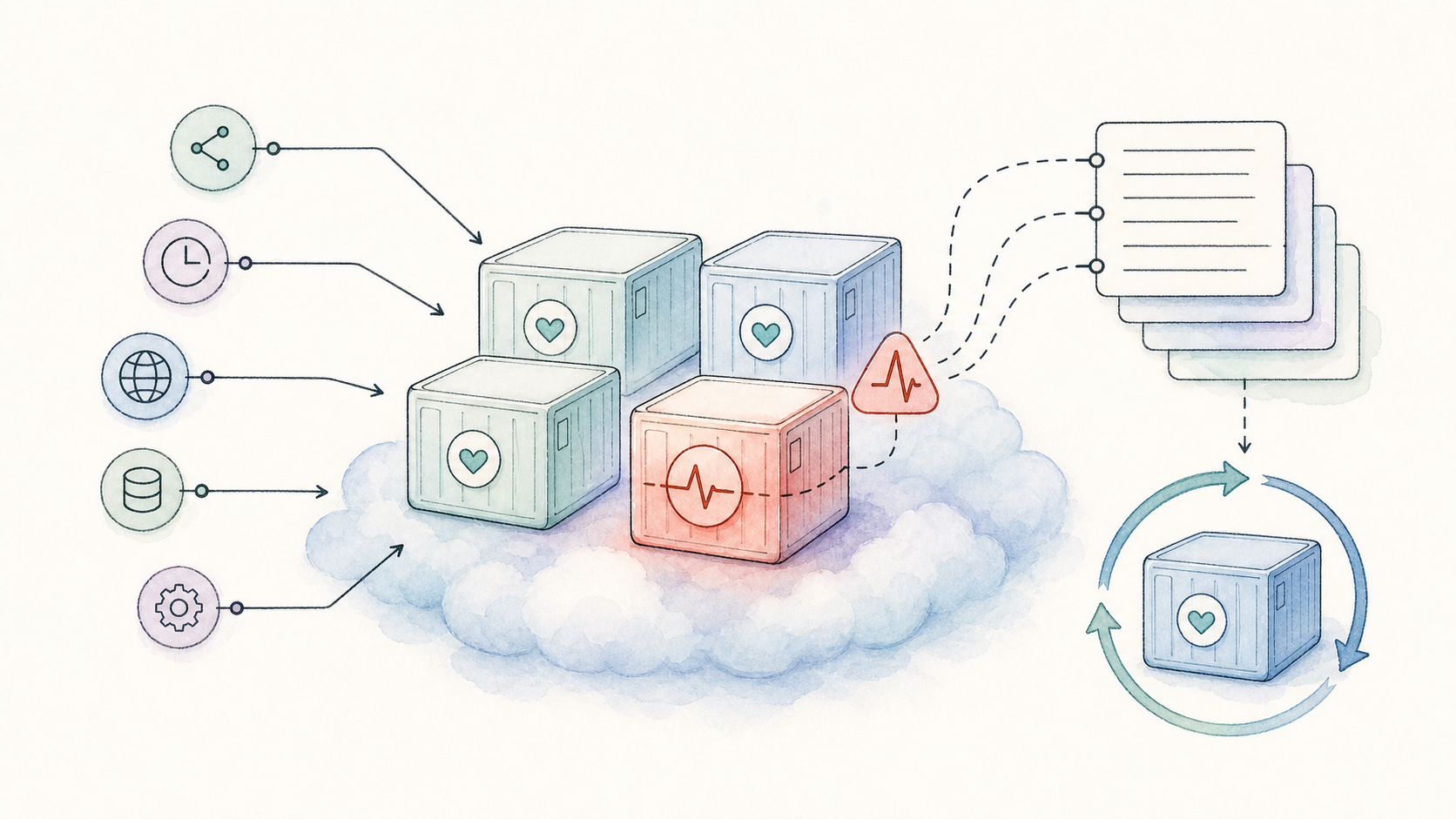
Your container is running. docker ps shows it’s up. But the status column says unhealthy – and you’re not sure what’s actually broken.
Docker’s health check system is a runtime verification mechanism: it doesn’t just check if the process is alive, it runs a command inside the container to verify the application is actually working. When that command fails, Docker marks the container unhealthy.
This guide covers diagnosis, common root causes, fix patterns, and how to prevent health check failures before they hit production.
What “Unhealthy” Actually Means
Docker health checks run independently of the container’s main process. Even if docker ps shows Up 10 minutes, the application inside might be broken – a port not listening, a database connection refused, a disk full.
Every health check produces an exit code:
– 0 – healthy
– 1 – unhealthy
– 2 (or any other non-zero) – reserved; Docker treats it as a warning, status unchanged
A container is marked unhealthy after the health check fails retries consecutive times (default: 3). Until then, it stays in starting or healthy.
This is fundamentally different from a crashed container. An unhealthy container is still running – Docker doesn’t kill it automatically. It’s up to your restart policy, orchestrator, or monitoring to react.
Quick Diagnosis: Is It Really Unhealthy?
Start with the container’s health log. This shows every health check run, its exit code, and any output:
docker inspect --format='{{json .State.Health}}' my-container | jqCode language: Bash (bash)You’ll see something like:
{
  "Status": "unhealthy",
  "FailingStreak": 5,
  "Log": [
    {
      "Start": "2026-06-15T10:00:00Z",
      "End": "2026-06-15T10:00:03Z",
      "ExitCode": 1,
      "Output": "curl: (7) Failed to connect to localhost port 8080: Connection refused\n"
    }
  ]
}Code language: JSON / JSON with Comments (json)
Key fields to check:
– FailingStreak – how many consecutive failures (≥ retries = unhealthy)
– ExitCode – 1 means the health check command itself failed
– Output – the actual error message from the health check command
To filter only unhealthy containers across your system:
docker ps --filter "health=unhealthy"Code language: Bash (bash)To watch health status changes in real time:
docker events --filter event=health_statusCode language: Bash (bash)Common Root Causes and How to Fix Them
When a container shows unhealthy, the root cause usually falls into one of five categories. Here is how to diagnose and fix each one.
1. Application Not Listening on the Expected Port
Symptom: curl: (7) Failed to connect to localhost port 8080: Connection refused
The most common cause. Your health check tries to reach localhost:8080/health, but the application either hasn’t started yet or is listening on a different port.
Diagnose inside the container:
docker exec my-container sh -c 'curl -v http://localhost:8080/health'Code language: Bash (bash)Or check what’s actually listening:
docker exec my-container netstat -tlnpCode language: Bash (bash)Fix:
– Verify the app’s actual listening port matches the health check
– Check that the app binds to 0.0.0.0, not 127.0.0.1 (Docker’s port mapping requires 0.0.0.0)
– For slow-starting apps, increase --start-period
HEALTHCHECK --start-period=60s --retries=5 \
  CMD curl -f http://localhost:3000/health || exit 1Code language: Dockerfile (dockerfile)
2. Missing Dependencies
Symptom: psql: could not connect to server: Connection refused or redis-cli: Could not connect to Redis
Your app needs a database or cache, but the dependent service isn’t ready when the health check runs.
Quick check: run the health check command manually inside the container:
docker exec my-app sh -c 'pg_isready -h db -U postgres'Code language: Bash (bash)Fix in Docker Compose:
services:
  app:
    depends_on:
      db:
        condition: service_healthy
    healthcheck:
      test: ["CMD", "curl", "-f", "http://localhost:8080/health"]
      interval: 10s
      start_period: 30s
  db:
    image: postgres:16
    healthcheck:
      test: ["CMD-SHELL", "pg_isready -U postgres"]
      interval: 5s
      retries: 5Code language: YAML (yaml)
The condition: service_healthy clause waits for the database to pass its own health check before starting the app container.
For complex dependency chains, a custom health check script can verify multiple services:
#!/bin/sh
pg_isready -h db -U postgres || exit 1
redis-cli -h cache ping || exit 1
curl -f http://localhost:8080/health || exit 1Code language: Bash (bash)
3. Resource Exhaustion
Symptom: Empty output, long timeouts, or curl: (28) Operation timed out
The container hit a resource limit – memory, CPU, or disk.
Diagnose:
docker stats my-container --no-streamCode language: Bash (bash)Check disk inside the container:
docker exec my-container df -hCode language: Bash (bash)For OOM (out of memory) kills, check dmesg on the host or the container’s exit code (137 = killed by OOM).
Fix:
– Increase memory limits: docker run -m 512m my-app
– Add log rotation to prevent disk fill
– Set appropriate --timeout on the health check (default 30s – too long for a sluggish container):
HEALTHCHECK --timeout=5s --retries=3 \
  CMD curl -f http://localhost:8080/health || exit 1Code language: Dockerfile (dockerfile)
4. Misconfigured HEALTHCHECK Command
Symptom: exec: "healthcheck.sh": permission denied or curl: not found
Common mistakes in the Dockerfile:
Missing executable permission:
# Wrong – script isn't executable
COPY healthcheck.sh /usr/local/bin/
HEALTHCHECK CMD /usr/local/bin/healthcheck.sh

# Right
COPY healthcheck.sh /usr/local/bin/
RUN chmod +x /usr/local/bin/healthcheck.sh
HEALTHCHECK CMD /usr/local/bin/healthcheck.shCode language: Dockerfile (dockerfile)
Missing curl in the image:
Minimal base images (Alpine, distroless) don’t include curl. Either install it:
FROM alpine:3.20
RUN apk add --no-cache curl
HEALTHCHECK CMD curl -f http://localhost:8080/health || exit 1Code language: Dockerfile (dockerfile)
Or use an alternative like wget:
HEALTHCHECK CMD wget --spider -q http://localhost:8080/health || exit 1Code language: Dockerfile (dockerfile)Wrong shell in exec form. The exec form CMD ["curl", "-f", "..."] doesn’t use a shell – so || exit 1 won’t work:
# Wrong – pipe/OR syntax needs a shell
HEALTHCHECK CMD ["curl", "-f", "http://localhost:8080/health", "||", "exit", "1"]

# Right – use CMD-SHELL or CMD with a string
HEALTHCHECK CMD curl -f http://localhost:8080/health || exit 1Code language: Dockerfile (dockerfile)
5. Aggressive Health Check Timing
Symptom: Container flaps between healthy and unhealthy every few seconds.
The health check --timeout is too tight for the application’s actual response time under load, or --interval runs checks faster than the app can recover.
Fix – tune parameters for your workload:
| Parameter | Default | Recommendation |
|---|---|---|
--interval | 30s | 10–30s. Shorter for critical services, longer for batch jobs |
--timeout | 30s | 2–5s for HTTP checks. Set to the app’s real p99 response time |
--retries | 3 | 3–5 for tolerance, 1–2 for fast failover in orchestrators |
--start-period | 0s | 30–60s if your app has a slow bootstrap |
Example for a Java app with a 40-second startup:
HEALTHCHECK --interval=15s --timeout=5s --start-period=60s --retries=3 \
  CMD curl -f http://localhost:8080/actuator/health || exit 1Code language: Dockerfile (dockerfile)
Fix Patterns That Work
Once you have identified the root cause, apply one of these three patterns to get your container back to healthy.
Pattern 1: Fix and Recreate
If the health check itself is wrong (wrong port, missing binary), fix the Dockerfile or Compose file and recreate:
docker compose up -d --force-recreate appCode language: Bash (bash)Pattern 2: Restart Policy + Autoheal
Docker’s restart policy (--restart=always) doesn’t react to health status – it only restarts on process exit. To restart unhealthy containers automatically, you need a sidecar. The simplest option:
docker run -d --name autoheal \
  -e AUTOHEAL_CONTAINER_LABEL=all \
  -v /var/run/docker.sock:/var/run/docker.sock \
  willfarrell/autohealCode language: Bash (bash)
Or build self-healing into the health check itself – force an exit to trigger the restart policy:
HEALTHCHECK CMD curl -f http://localhost:8080/health || kill -s 15 1Code language: Dockerfile (dockerfile)When curl fails, the health check kills PID 1 (the main process), the container exits, and Docker’s restart policy kicks in.
Pattern 3: Docker Compose with depends_on
For multi-service apps, chain health checks so services start in the right order:
services:
  api:
    depends_on:
      postgres:
        condition: service_healthy
      redis:
        condition: service_healthy
    healthcheck:
      test: ["CMD", "curl", "-f", "http://localhost:3000/health"]
  postgres:
    image: postgres:16
    healthcheck:
      test: ["CMD-SHELL", "pg_isready -U app"]
      interval: 3s
      retries: 10
  redis:
    image: redis:7-alpine
    healthcheck:
      test: ["CMD", "redis-cli", "ping"]Code language: YAML (yaml)
Docker vs Kubernetes: The Liveness Probe Connection
If you work with both Docker and Kubernetes, the concepts map directly:
| Docker | Kubernetes |
|---|---|
HEALTHCHECK instruction | livenessProbe |
--interval | periodSeconds |
--timeout | timeoutSeconds |
--retries | failureThreshold |
--start-period | initialDelaySeconds |
docker inspect .State.Health | kubectl describe pod |
The key difference: Kubernetes kills and restarts the pod when the liveness probe fails. Docker only marks the container unhealthy – restarting is up to you (or your orchestrator).
If you’re designing health checks for an app that runs on both Docker Compose (local/dev) and Kubernetes (production), use the same endpoint and similar thresholds.
Prevention: Writing Health Checks That Don’t Lie
A bad health check is worse than no health check. It gives a false sense of safety while the app burns.
Do:
– Check the actual application endpoint, not just “port is open”
– Keep the check fast and lightweight (under 1 second normally)
– Use a dedicated /health or /ready endpoint that verifies critical dependencies (DB, cache, message queue)
– Test the health check locally: docker exec my-container
Don’t:
– Just curl localhost without --fail – HTTP 500 still returns exit 0
– Run expensive checks (database migrations, disk scans) inside the health check
– Use pg_isready alone for PostgreSQL – it only checks if the server accepts connections, not if the database is actually ready for queries
– Leave --timeout at the default 30s – a hung health check blocks status updates for 30 seconds
Good health check example for a web app:
HEALTHCHECK --interval=15s --timeout=3s --start-period=20s --retries=3 \
  CMD curl -f http://localhost:3000/health || exit 1Code language: Dockerfile (dockerfile)
The /health endpoint itself verifies DB connectivity and returns 200 only when everything is ready.
Good health check for a worker (no HTTP):
HEALTHCHECK --interval=30s --timeout=5s --retries=3 \
  CMD pgrep -f "sidekiq" || exit 1Code language: Dockerfile (dockerfile)
Summary
– Unhealthy ≠ crashed. The container is running, but the app inside isn’t working as expected
– Start with docker inspect – the health log tells you exactly what failed
– Run the health check command manually inside the container to reproduce the issue
– Most failures are wrong port, missing dependency, resource exhaustion, or misconfigured HEALTHCHECK
– For production, pair health checks with restart policies, Compose depends_on, or Kubernetes liveness probes
—
Internal links: Docker Compose Healthcheck · Docker Logs: View, Tail, and Grep · Docker Compose Restart Policy · Docker Compose Stop · Docker Compose Down
How is “unhealthy” different from “exited”?
Exited means the main process stopped – the container is dead. Unhealthy means the main process is still running, but the health check command is failing. An unhealthy container can become healthy again if the next checks pass.
Does Docker restart an unhealthy container automatically?
No. Docker’s --restart policy only reacts to the process exiting (stopped or killed), not to health status changes. To auto-restart unhealthy containers, use a tool like autoheal or build a kill command into the health check itself.
Can I change the health check on a running container?
No. Health checks are baked into the image (Dockerfile) or set at container creation (docker run --health-cmd). To change the health check, update the Dockerfile or run command and recreate the container.
What’s the difference between CMD and CMD-SHELL in health checks?
CMD uses exec form – no shell, no variable expansion, no pipes. CMD-SHELL runs through /bin/sh -c, so you can use &&, ||, and shell variables. For health checks that combine multiple commands or need || exit 1, use CMD (string form) or CMD-SHELL.
Why is my container stuck on “starting”?
The container is in its --start-period window, or the health check hasn’t reached the required number of successes yet. If it stays starting forever, the health check command is probably hanging. Check with docker inspect to see if the Log array contains any entries – empty Log means the health check never completed.
Can I disable health checks for a specific container?
Yes, at run time: “`bash docker run –no-healthcheck my-image “` This overrides any HEALTHCHECK instruction in the Dockerfile and marks the container as healthy (no health check configured).





Leave a Reply