

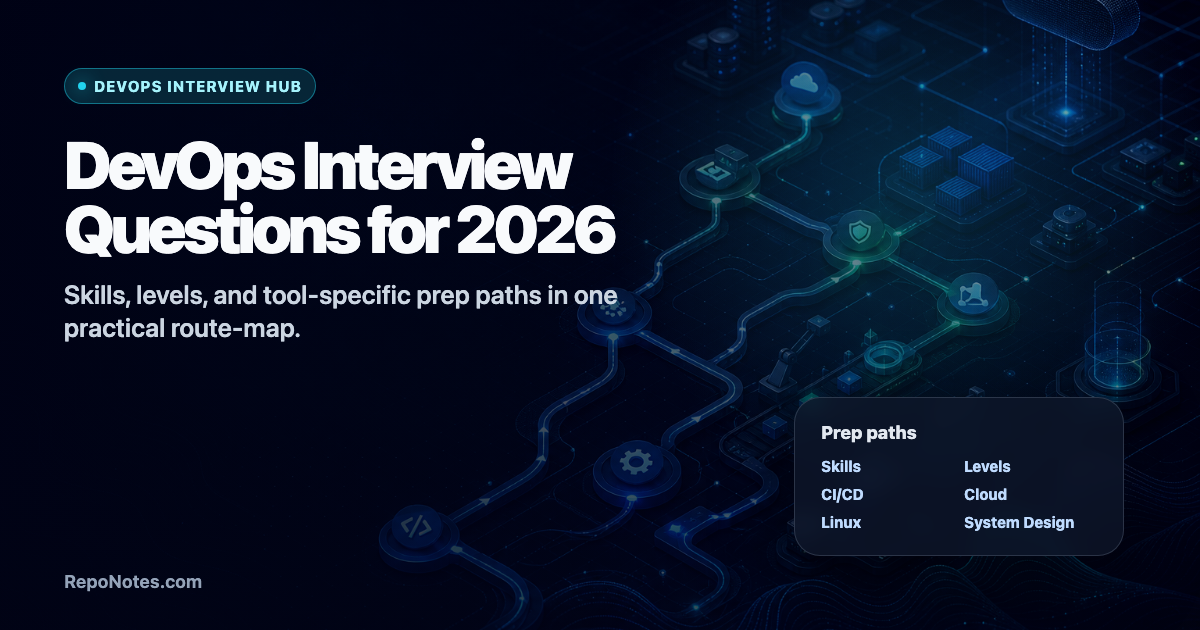
Use this page as a preparation map, not a memorization sheet. DevOps interviews can cover delivery, operations, cloud, automation, troubleshooting, collaboration, and leadership. This hub helps you choose what to study first and points you to deeper RepoNotes guides when a topic needs focused practice.
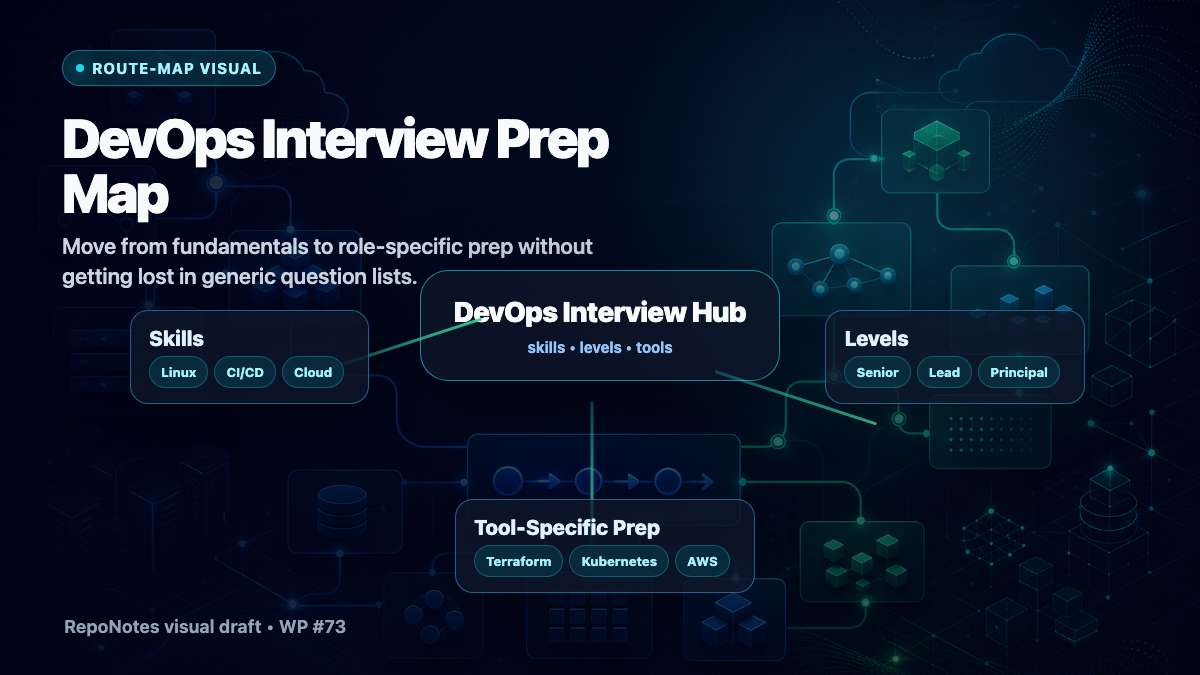
Quick takeaway: Start with the broad map here, then follow the level, tool, or scenario path that matches your interview. If you already know your target role, skip directly to the relevant section and use the linked deep dives for practice.
What DevOps Interviews Actually Test
DevOps interviews rarely test only tool trivia. Strong interviewers look for delivery judgment, operational ownership, automation habits, and the ability to explain tradeoffs. That is why this hub uses a competency map rather than a flat list of disconnected questions. For a broader definition of DevOps, compare the framing from Microsoft Learn, AWS, GitLab, and Red Hat.
A practical preparation plan should also connect to performance and reliability outcomes. The DORA capabilities and DORA research are useful because they move the conversation from “which tool do you know?” to “how do you improve deployment frequency, lead time, reliability, recovery, and change safety?”
| Interview area | What interviewers are checking | Good evidence to prepare |
|---|---|---|
| Delivery fundamentals | Can you explain how code moves from commit to production? | A real CI/CD flow, approval gates, rollback path, and one failure you debugged. |
| Operations and reliability | Can you keep systems observable and recoverable? | Monitoring signals, alert examples, incident timeline, postmortem action. |
| Automation and IaC | Can you make infrastructure repeatable and reviewable? | Terraform, Ansible, GitOps, drift handling, and safe change review. |
| Cloud and containers | Can you choose and operate platform primitives? | VPC, IAM, Kubernetes, containers, managed services, cost and security tradeoffs. |
| Collaboration and ownership | Can you work across dev, ops, security, and product? | Examples of communication, prioritization, mentoring, and risk negotiation. |
Start Here: Core DevOps Interview Questions
Use these broad questions to check whether your foundation is ready. Keep answers concrete: mention a system, a constraint, a tradeoff, and how you verified the result.
- What changed in the delivery process after your team adopted DevOps practices?
- How would you design a CI/CD pipeline for a service that needs fast rollback?
- What does “infrastructure as code” change in review, testing, and recovery?
- How do containers help delivery, and where do they add operational risk?
- What monitoring signals would you use before and after a production release?
- How do you handle secrets, credentials, and least privilege in delivery pipelines?
- Tell me about a deployment failure you investigated. What was the root cause and what changed afterward?
Choose Your Level-Based Prep Path
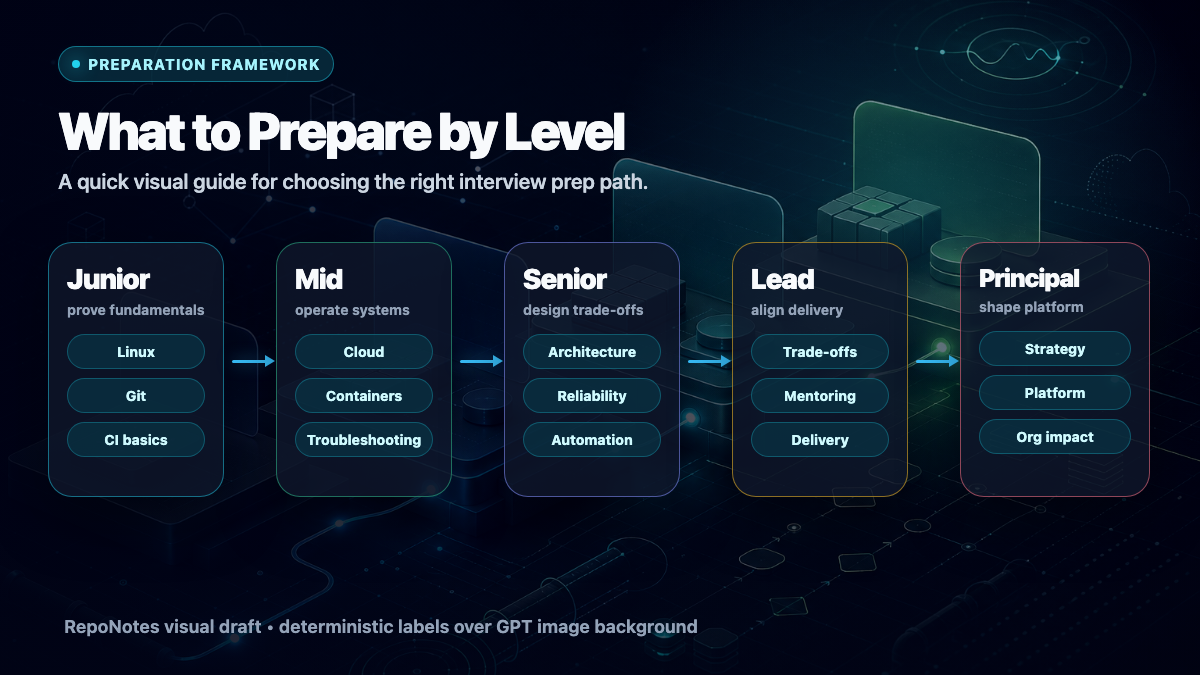
A junior interview and a principal interview should not sound the same. Use this section to choose the right depth. The hub stays broad; the linked pages go deeper into level-specific expectations.
| Path | Use this when | Next RepoNotes guide |
|---|---|---|
| Junior / entry level | You need practical fundamentals, Linux/Git basics, and simple troubleshooting stories. | Junior DevOps interview questions |
| Senior DevOps | You need ownership stories, production incidents, scaling tradeoffs, and mentoring examples. | Senior DevOps interview questions |
| Lead DevOps | You need to show technical leadership, prioritization, delivery strategy, and team influence. | Lead DevOps interview questions |
| Principal DevOps | You need architecture judgment, platform strategy, cross-team standards, and long-term tradeoffs. | Principal DevOps interview questions |
| DevOps Architect | You need a systems view across cloud, networking, security, reliability, governance, and delivery. | Draft path: DevOps Architect interview guide |
Choose Your Tool and Platform Prep Path
For tooling breadth, the roadmap.sh DevOps roadmap is a useful map, but interviews usually need applied examples. Do not only name tools. Explain when you used them, what broke, and how you knew the fix worked.
| Topic | What to prepare | Deep-dive guide |
|---|---|---|
| Linux | Processes, permissions, logs, networking, systemd, disk and memory checks. | Linux interview questions for DevOps |
| Git | Branching, rollback, conflict resolution, release hygiene, and debugging bad history. | Git interview questions for DevOps |
| CI/CD | Pipeline design, test gates, artifacts, environments, approvals, and rollback. | CI/CD interview questions |
| Jenkins | Pipelines, credentials, agents, shared libraries, and troubleshooting builds. | Jenkins interview questions |
| Terraform | State, modules, drift, plan review, imports, workspaces, and safe applies. | Terraform interview questions for DevOps |
| Ansible | Inventory, idempotency, roles, variables, handlers, templates, and connectivity checks. | Ansible interview questions |
| AWS | IAM, networking, compute, storage, monitoring, cost, and deployment patterns. | AWS DevOps interview questions |
| GCP | IAM, projects, networking, Cloud Build, GKE, monitoring, and operational tradeoffs. | GCP interview questions for DevOps |
Scenario Questions That Separate Strong Candidates
Scenario questions are where a hub page can add value without duplicating every tool-specific guide. Prepare compact stories that show diagnosis, tradeoff thinking, and verification.
| Scenario | What a strong answer includes | Useful next read |
|---|---|---|
| A deployment fails after release | Blast radius, rollback criteria, logs/metrics, owner communication, follow-up fix. | Release management interview questions |
| A pipeline is slow and flaky | Stage timing, cache strategy, test split, artifact reuse, and failure classification. | CI/CD interview questions |
| Infrastructure drift appears | Source of truth, plan review, import or recreate choice, state safety, peer review. | Terraform interview questions for DevOps |
| A Linux host is unhealthy | CPU, memory, disk, network, service status, logs, and recent changes. | Linux interview questions for DevOps |
| Monitoring missed an incident | Signal quality, alert thresholds, SLOs, dashboards, postmortem action. | DevOps monitoring tools and best practices |
How to Build Strong Answers
The best answers are not long. They are specific. Use this structure when practicing: context, constraint, action, verification, lesson. For example, instead of saying “I improved CI/CD,” explain what the pipeline looked like before, which bottleneck you fixed, how you measured the result, and what tradeoff remained.
- Anchor delivery and reliability answers in measurable outcomes. DORA is useful here because it connects engineering practices to delivery performance and recovery outcomes: DORA research.
- Use official docs when you make platform claims. For example, use HashiCorp Terraform Associate review for Terraform topic coverage and GitHub Actions docs for CI/CD concepts.
- For Kubernetes-heavy interviews, certification outlines like the Linux Foundation CKA can help you identify core operational areas, even if the job is not asking for a certification.
- Avoid unsupported claims like “everyone now uses tool X.” Say what the tool solves, where it fails, and how you decide whether it fits the team.
A 48-Hour DevOps Interview Prep Plan
If the interview is close, do not try to study every tool. Use a focused plan that covers broad signals first, then the role-specific path.
| Time box | What to do | Output |
|---|---|---|
| First 4 hours | Read the job description and mark each requirement as fundamentals, tool, cloud, platform, or leadership. | A prioritized study list. |
| Next 8 hours | Refresh Linux, Git, CI/CD, IaC, cloud basics, and monitoring. | One short answer and one example per area. |
| Next 12 hours | Follow the most relevant deep-dive guides from this hub. | Tool-specific practice notes. |
| Next 12 hours | Prepare 4 stories: deployment failure, incident response, automation improvement, cross-team tradeoff. | STAR-style stories with verification details. |
| Final 12 hours | Practice aloud and remove vague phrases. | Clear answers with concrete systems, constraints, and outcomes. |
Where This Hub Should Link Next
As RepoNotes grows, this page should stay the central map. New role, tool, or platform interview pages should link back here, and this hub should link out when the deeper guide is useful. That keeps the broad page useful without turning it into a duplicate of every specific guide.
- For broad implementation examples, use DevOps examples and practical patterns.
- For cloud-specific paths, route AWS readers to AWS DevOps interview questions and GCP readers to GCP interview questions for DevOps.
- For source-control and operating-system basics, route readers to Git interview questions and Linux interview questions.
- For automation paths, route readers to Terraform interview questions and Ansible interview questions.
FAQ
Use these broad answers for orientation. If you need tool-specific examples, follow the relevant internal links above.
How should I use this DevOps interview hub?
Start with the topic map, then follow the path that matches your interview: junior, senior, lead, architect, AWS, GCP, Terraform, Linux, Git, CI/CD, or incident response. Use the hub for broad preparation and the linked guides for deeper practice.
What do DevOps interviews usually test?
Most interviews test a mix of delivery fundamentals, CI/CD, infrastructure as code, containers, cloud operations, monitoring, incident response, security habits, and collaboration. Senior roles add architecture tradeoffs, reliability, ownership, and mentoring.
Should I memorize DevOps interview questions?
No. Memorized answers are weak. Prepare short stories, commands you can explain, tradeoffs you have seen, and failure scenarios you can debug. Use questions as prompts for practice, not scripts to recite.
Which DevOps topics should I study first?
Start with Linux, Git, CI/CD, containers, cloud basics, infrastructure as code, monitoring, and deployment rollback. Then specialize by role or tool: Terraform, AWS, GCP, Jenkins, Ansible, Kubernetes, or release management.
How is this hub different from tool-specific interview guides?
This page gives the preparation map. Tool-specific pages go deeper into focused questions, examples, and scenarios. The hub should help you choose the right next guide instead of duplicating every question.

Leave a Reply